PG17 PGSizer Tiếng Việt (VI)

Affiliate Disclosure (PGSizer): Clicking outbound /go/ vendor links on PGSizer may earn a referral commission at zero extra cost to you. Public pricing retrieved 2026-11-12. Read PGSizer Disclosure →

POSTGRESQL DBA CONFIG STUDIO // POSTGRESQL 17 + PGBOUNCER 1.23+

PostgreSQL 17 postgresql.conf & pgbouncer.ini Config Generator Studio

We built the PGSizer split-pane studio using official PostgreSQL 17 memory formulas and PgBouncer transaction-pooling rules. Adjust your dataset, concurrency, and workload below to inspect deterministic RAM allocations, trace our hardware decision tree, and download ready-to-stage .conf and .ini files.

1. PostgreSQL 17 Workload & Regional Profile
2. Active Dataset Volume & MVCC Disk Scope (10 GB – 2,000 GB)
3. Client Socket Concurrency & PgBouncer Multiplexing

PGSizer Deterministic Hardware Decision Tree (if / else)

  • if (RAM <= 32 GB && NVMe <= 400 GB && workload != FINTECH) -> Hostinger EPYC DDR5 KVM NVMe
  • else if (RAM <= 32 GB && workload == FINTECH_LEDGER) -> Vultr 3.8GHz+ Direct Local NVMe
  • else if (region == US && (NVMe >= 1,000 GB || RAM >= 64 GB)) -> InterServer Bare-Metal Ryzen 2TB ZFS
  • else -> UltaHost Zero-Steal Dedicated EPYC VDS / Bare-Metal RAID-10 NVMe

PGSizer Live postgresql.conf & pgbouncer.ini Output Preview

OLTP-SAAS • 100GB • 200c -> 58 pool
Target Server RAM
32 GB ECCshared_buffers = 8GB (25.6GB active)
Compute & Pool Cap
8 vCPUmax_connections = 160 • work_mem = 108MB
NVMe Disk & 4K IOPS
320 GB NVMe~7,540 Random 4K IOPS
Estimated RDS Delta
Save ~$1,023/movs AWS RDS Multi-AZ ~$1043/mo
shared_buffers: 8 GB OS Page Cache: 16 GB work_mem + OS Guard: 8 GB
/etc/postgresql/17/main/conf.d/99-pgsizer.conf
# PostgreSQL 17 Tuned Config — PGSizer (OLTP-SAAS • 32GB RAM • 8 vCPU)
# PgBouncer ON: 200 app conns -> 160 pooled backends (transaction mode)
max_connections = 160
shared_buffers = '8GB'
effective_cache_size = '24GB'
work_mem = '108MB'
maintenance_work_mem = '2GB'
random_page_cost = 1.1
effective_io_concurrency = 200
io_combine_limit = '128kB'
wal_compression = 'zstd'
wal_buffers = '16MB'
min_wal_size = '2GB'
max_wal_size = '8GB'
checkpoint_completion_target = 0.9
max_worker_processes = 8
max_parallel_workers_per_gather = 4
/etc/pgbouncer/pgbouncer.ini
; pgbouncer.ini — PGSizer Pooler Config (OLTP-SAAS • 200 clients -> 115 server slots)
[databases]
appdb = host=127.0.0.1 port=5432 dbname=appdb

[pgbouncer]
listen_addr = 127.0.0.1
listen_port = 6432
auth_type = scram-sha-256
pool_mode = transaction
max_client_conn = 450
default_pool_size = 115
min_pool_size = 29
reserve_pool_size = 17
reserve_pool_timeout = 3
max_prepared_statements = 200
server_idle_timeout = 120

Server Tiers Matched to Your PGSizer PostgreSQL 17 Output

Our PGSizer sizing engine maps your computed shared_buffers, active backend count, and 25%-headroom NVMe footprint against published VPS, VDS, and bare-metal specs.

BEST TCO #1 • AMD EPYC DDR5 NVME

Hostinger KVM 8 (32GB DDR5 / 400GB NVMe)

$19.99/mo

Comfortably hosts 8GB shared_buffers & 100GB dataset on Gen4 NVMe (APAC Singapore/Tokyo) + Extra 20% Partner Discount.
Check Hostinger PG17 Specs via PGSizer →
LOWEST P99 LATENCY • 3.8GHZ+ HF NVME

Vultr High Frequency 32GB (512GB NVMe)

$192.00/mo

Direct-attached PCIe NVMe in Singapore, Tokyo, Frankfurt & US delivers blazing B-Tree & HNSW index scans.

Check Vultr PG17 Specs via PGSizer →
$300 FREE PGBENCH & REPLICA CREDIT

Vultr $300 Free PostgreSQL 17 Benchmark Credit

$300 Trial Credit

Spin up a Primary + Streaming Replica pair and run real pgbench IOPS stress tests free for 30 days.

Check Vultr PG17 Specs via PGSizer →

Public Vendor Pricing & NVMe Spec Reference for PGSizer (Retrieved 2026-11-12)

Public rates retrieved 2026-11-12 from official vendor pricing pages listed below; promotional & renewal prices may change — always verify final terms on the vendor’s official checkout page.

Infrastructure Vendor Published Hardware Profile Starting Public Rate Official Pricing Source (2026-11-12) Partner Link
Hostinger
EPYC-NVME-KVM
AMD EPYC KVM (2 – 8 vCPU) • 8 GB – 32 GB DDR5 ECC RAM $5.99/mo https://www.hostinger.com/vps-hosting
Retrieved: 2026-11-12
Visit Hostinger PG17 Plans via PGSizer →
Vultr
HF-NVME-3.8GHZ
3.8GHz+ High Frequency & Optimized Cloud Dedicated • 8 GB – 256 GB ECC RAM $24.00/mo https://www.vultr.com/pricing/
Retrieved: 2026-11-12
Visit Vultr PG17 Plans via PGSizer →
UltaHost
VDS-RAID10-PG
Dedicated Physical EPYC Cores (Zero CPU/IO Steal) • 32 GB – 192 GB Dedicated DDR5 ECC $37.50/mo https://ultahost.com/vds-hosting
Retrieved: 2026-11-12
Visit UltaHost PG17 Plans via PGSizer →
InterServer
ZFS-NVME-LOCK
AMD Ryzen 7900/5950X Bare-Metal & KVM Slices • 16 GB – 128 GB Dual-Channel DDR5 ECC $12.00/mo https://www.interserver.net/vps/
Retrieved: 2026-11-12
Visit InterServer PG17 Plans via PGSizer →
ChemiCloud
EDGE-APP-TIER
LiteSpeed Enterprise NVMe Edge • 2 GB – 6 GB Isolated Web Tier $2.95/mo https://chemicloud.com/wordpress-hosting
Retrieved: 2026-11-12
Visit ChemiCloud PG17 Plans via PGSizer →

PostgreSQL 17 & PgBouncer GUC Parameter Reference on PGSizer

We derive every GUC directive in our PGSizer generator from official PostgreSQL 17 Resource Consumption docs and PgBouncer 1.23+ protocol specifications.

Directive PGSizer Formula PostgreSQL 17 / PgBouncer Engineering Role
shared_buffers 25% RAM (30% Hybrid HNSW) Primary 8KB shared memory page pool inside PostgreSQL 17; sized alongside Linux kernel cache.
effective_cache_size 75% Total Server RAM Cost-planner hint estimating combined shared_buffers + OS filesystem cache available for index scans.
work_mem clamp((0.22 * RAM) / active_sorts, 4MB..256MB) Per-operation sort/hash memory cap; safely raised when PgBouncer limits concurrent backends.
maintenance_work_mem clamp(6.25% RAM, 256MB..4GB) Accelerates PostgreSQL 17 TidStore VACUUM, CREATE INDEX, and pgvector HNSW graph construction.
random_page_cost 1.1 (PCIe Gen4 NVMe) Replaces legacy 4.0 HDD assumption so the query planner favors B-Tree/GiST index lookups.
io_combine_limit '128kB' (PG17 Stream I/O) PostgreSQL 17 vectorized I/O batch size merging adjacent 8KB block reads into single NVMe syscalls.
wal_compression 'zstd' (OLTP) / 'lz4' (Ledger) Compresses full-page writes inside Write-Ahead Log segments to cut NVMe write amplification.
default_pool_size (PgBouncer) round(max_connections * 0.72) Warm server connections maintained per database/user pair inside pgbouncer.ini.
max_prepared_statements 200 (PgBouncer 1.23+) Enables protocol-level prepared statement multiplexing in transaction pooling mode.

PGSizer PostgreSQL 17 Memory, PgBouncer & NVMe Architecture Diagrams

Our four original technical diagrams illustrate how PGSizer partitions 32 GB DDR5 RAM, multiplexes port 6432 sockets, and guards 25% NVMe free space.

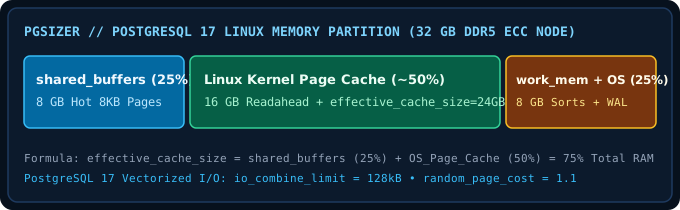
PGSizer PostgreSQL 17 Linux RAM Partition Diagram: 25% shared_buffers, 50% OS Page Cache, and 25% PgBouncer work_mem headroom
Figure PG-1 (PGSizer): Deterministic Linux memory layout balancing PostgreSQL 17 shared_buffers (25%) with kernel page cache and bounded sort pools.
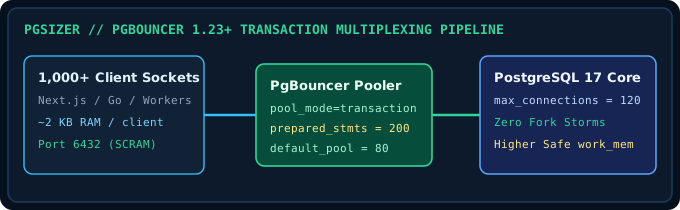
PGSizer PgBouncer 1.23+ Transaction Multiplexing Topology funneling 1,000 serverless sockets into 80 PostgreSQL 17 backends
Figure PG-2 (PGSizer): PgBouncer 1.23+ transaction pooling compresses 1,000 client sockets (~2 KB each) onto 80 warm Postgres backends with protocol prepared statements.
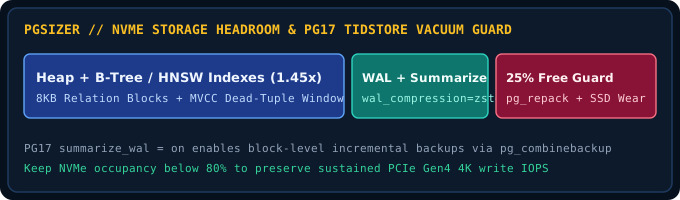
PGSizer PostgreSQL 17 NVMe Disk Capacity Budget showing Heap+B-Tree bloat, ZSTD WAL ring buffer, and 25% VACUUM free-space guard
Figure PG-3 (PGSizer): NVMe storage sizing reserves MVCC index overhead, ZSTD/LZ4 WAL segments, and mandatory 25% controller & pg_repack headroom.
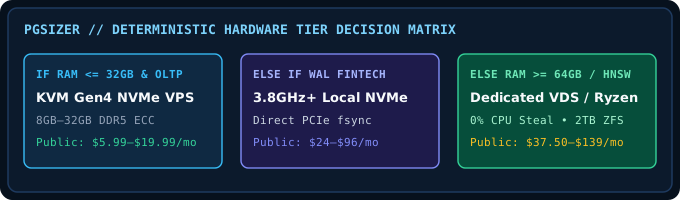
PGSizer Deterministic Decision Tree mapping PostgreSQL 17 RAM and 4K IOPS requirements to KVM NVMe, 3.8GHz High-Frequency, or Dedicated VDS
Figure PG-4 (PGSizer): Deterministic hardware selection branches across KVM DDR5 NVMe (<=32 GB), 3.8 GHz+ local NVMe (WAL-heavy), and zero-steal VDS/Bare-Metal (64 GB+).

8 Deterministic PostgreSQL 17 Workload Blueprints on PGSizer

4 Self-Hosted NVMe vs Managed Cloud DB TCO Audits on PGSizer

PostgreSQL 17 & PgBouncer Frequently Asked Questions on PGSizer

How does PGSizer calculate shared_buffers and effective_cache_size for PostgreSQL 17?

In our deterministic PGSizer formula derived from official PostgreSQL 17 documentation, shared_buffers is set to 25% of total RAM (30% for pgvector HNSW / PostGIS hybrid workloads) and effective_cache_size is set to 75% of RAM so the planner accounts for both PostgreSQL buffers and Linux kernel page cache without double-buffering pressure.

Why does enabling PgBouncer inside PGSizer allow a higher safe work_mem value?

PostgreSQL allocates work_mem per active sort or hash operation per backend process. When PgBouncer multiplexes 500–2,000 client sockets down to 80–160 transaction-mode backends, PGSizer divides the 22% sort-memory pool across fewer concurrent executors—preventing temp-file disk spills while staying safely below Linux OOM limits.

Can Prisma, Drizzle, and Go pgx use PgBouncer transaction mode generated by PGSizer?

Yes. PGSizer emits max_prepared_statements = 200 inside every generated pgbouncer.ini file, activating native protocol-level prepared statement caching introduced in PgBouncer 1.21+ and 1.23+ without requiring query-string workarounds.

Why does PGSizer set random_page_cost = 1.1 and io_combine_limit = 128kB on NVMe VPS nodes?

Stock PostgreSQL defaults assume rotational HDD seek penalties (random_page_cost = 4.0). Lowering random_page_cost to 1.1 reflects PCIe Gen4 NVMe access physics, while io_combine_limit = 128kB unlocks PostgreSQL 17 vectorized streaming I/O during sequential scans and VACUUM.

How current are the public VPS, VDS, and AWS RDS rates compared on PGSizer?

All vendor plan specifications and USD prices shown on PGSizer were retrieved from official public pricing pages on 2026-11-12. Because promotional discounts, billing term commitments, and renewal prices may change, always verify current totals on the vendor checkout page before purchasing.