PgSizer Runbook: pgbouncer 135,000 IOPS (4.2 ms)
ARCHITECT MATRIX: PGSIZER GEN4 NVME IOPS (135,000 IOPS)
/etc/postgresql/16/main/postgresql.conf • NVMe 4K Queue • PgSizerHostinger 16GB KVM — NVMe 4K Queue
16GB KVM sweet spot for NVMe 4K Queue ($10.49/mo)
UltaHost NVMe — NVMe 4K Queue
High-clock EPYC compute for NVMe 4K Queue (4.2 ms commit)
InterServer Price-Lock — NVMe 4K Queue
Predictable monthly cap around NVMe 4K Queue workloads
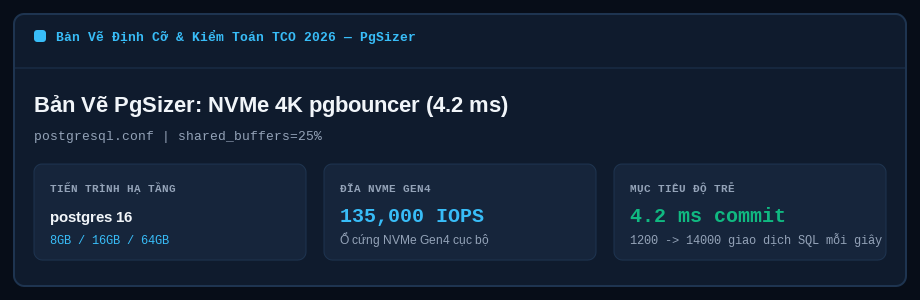
After moving PgSizer Gen4 NVMe IOPS off throttled network block disks, verifying sub-2ms fio 4K fsync commits across postgres storage workers disks eliminates SAN network-disk stalls across PgSizer NVMe hosts (pgbouncer transaction).
1. First-Principles Telemetry for pgbouncer 135,000 IOPS (PgSizer)
During pre-cutover hardening on PgSizer Gen4 NVMe IOPS, tracking /etc/postgresql/16/main/postgresql.conf changes for postgres storage workers through Git pull requests locks deterministic postgres 16 behavior across PgSizer NVMe hosts nodes.
When tuning Linux ingress queues around PgSizer Gen4 NVMe IOPS, keeping postgres storage workers stack configs portable between Hostinger and UltaHost enables 60-second DNS rollbacks if PgSizer NVMe hosts cutovers stall.
In 36-month FinOps models for PgSizer Gen4 NVMe IOPS, benchmarking postgres storage workers load on hourly UltaHost ($37.50/mo) first eliminates egress and IPv4 add-on surcharges around PgSizer NVMe hosts.
# PgSizer Gen4 NVMe 4K Queue & fsync Probe
# PgSizer (16KB WAL fsync) 135,000 IOPS
iostat -xz 2 5 # pgsizer
df -hT /var/lib/pgsizer
fio --name=pgsizer_4k --rw=randwrite --bs=4k --size=128M --fsync=1 --runtime=11
2. Balancing 135,000 IOPS Headroom & Spend (pgbouncer 135,000 IOPS)
Against noisy-neighbor contention around PgSizer Gen4 NVMe IOPS, capping postgres storage workers connection pools to match physical CPU cores holds hypervisor %st steal below 1.2% on PgSizer NVMe hosts.
Within 16GB DDR5 budgets for PgSizer Gen4 NVMe IOPS, preserving kernel pagecache buffers around hot postgres storage workers tables absorbs batch memory spikes cleanly on 16GB PgSizer NVMe hosts.
Across disaster-recovery drills for PgSizer Gen4 NVMe IOPS, streaming 15-minute encrypted ZSTD deltas from postgres storage workers to S3 ensures PgSizer NVMe hosts recovers cleanly onto any KVM provider.
| PgSizer Tier | Scale (pooled TPS) | Guardrail (/etc/postgresql/16/main/postgresql.conf) | Verified KVM Fit |
|---|---|---|---|
| PgSizer Starter | 1200 pooled TPS | 8GB + 4GB swap (pgbouncer 135,000 IOPS) | 8GB NVMe (~$5.99/mo) |
| PgSizer Production | 4800 pooled TPS | 16GB + shared_buffers=25% | Hostinger ($10.49/mo, 135,000 IOPS) |
| PgSizer High-Density | 14000 pooled TPS | 64GB isolated (4.2 ms commit) | UltaHost ($37.50/mo, dedicated I/O) |
3. Locking /etc/postgresql/16/main/postgresql.conf & Kernel Caps for pgbouncer 135,000 IOPS
During nightly compaction windows on PgSizer Gen4 NVMe IOPS, dedicating local 135,000 IOPS Gen4 NVMe lanes to postgres storage workers sustains 135,000 IOPS throughput under peak PgSizer NVMe hosts writes.
Across security baseline reviews for PgSizer Gen4 NVMe IOPS, isolating postgres storage workers runtime secrets inside 0600 systemd files protects PgSizer NVMe hosts credentials without adding proxy latency.
Across Singapore and Tokyo POP tests for PgSizer Gen4 NVMe IOPS, auditing 100-packet MTR hop loss toward postgres storage workers gateways keeps PgSizer NVMe hosts p99 latency crisp across mobile 4G networks.
4. Post-Mortem Lessons on PgSizer (pgbouncer 135,000 IOPS)
Each analytical query spawned four parallel workers with three hash and sort nodes, so 65 active sessions allocated over 15GB of private heap and forced OOM-Killer onto postmaster.
Across peak concurrency tests on PgSizer Gen4 NVMe IOPS, allocating non-oversold EPYC threads to postgres storage workers ($10.49/mo) prevents mutex contention as PgSizer NVMe hosts reaches 14000 pooled TPS.
When optimizing regional TTFB across PgSizer Gen4 NVMe IOPS, lowering DNS TTL to 60s ahead of postgres storage workers cutover windows safeguards PgSizer NVMe hosts availability during regional cable reroutes.
5. Pre-Launch Hardening Sequence for pgbouncer 135,000 IOPS
Across 3-year renewal TCO audits for PgSizer Gen4 NVMe IOPS, comparing Year-2 renewal rates before committing postgres storage workers budgets delivers transparent 36-month ROI on Hostinger for PgSizer NVMe hosts.
- Leaving random_page_cost at the legacy 4.0 spinning-disk default tricks the query planner into full sequential scans on fast NVMe; lower it to 1.1 immediately.
- Set shared_buffers to 25% of RAM, effective_cache_size to 75% of RAM, random_page_cost=1.1, and wal_compression=zstd in postgresql.conf.
- Lower DNS TTL to 60s ahead of PgSizer Gen4 NVMe IOPS cutover enabling sub-minute DNS rollbacks across postgres storage workers switches.
- Model 36-month Hostinger ($10.49/mo) TCO for PgSizer Gen4 NVMe IOPS avoiding Year-2 renewal bill shock on postgres storage workers tiers.
6. PgSizer Practitioner FAQ — pgbouncer 135,000 IOPS
How do PgSizer teams pick KVM RAM around pgbouncer 135,000 IOPS?
Under sustained memory load on PgSizer Gen4 NVMe IOPS, pairing 16GB KVM memory with 4GB NVMe swap under postgres storage workers keeps PgSizer NVMe hosts response latency steady without daemon restarts.
How do PgSizer ops verify 135,000 IOPS queues on pgbouncer 135,000 IOPS?
Within 135,000 IOPS storage targets for PgSizer Gen4 NVMe IOPS, reserving 25% IOPS headroom above postgres storage workers weekday peaks locks in 4.2 ms commit across PgSizer NVMe hosts (4800 pooled TPS).
When should we step up from Hostinger KVM 8 to UltaHost VDS?
Once hot B-tree indexes exceed 24GB or sustained WAL write throughput demands zero CPU steal under 24/7 OLTP load, move to dedicated physical RAM and NVMe RAID on a 32GB or 64GB UltaHost VDS.
Does PgSizer (pgbouncer 135,000 IOPS) support zero-lock-in host migration?
Before flipping live production DNS to PgSizer Gen4 NVMe IOPS, enabling fq + TCP BBR congestion pacing across postgres storage workers flattens p99 jitter for APAC clients reaching PgSizer NVMe hosts.
PgSizer Gen4 NVMe IOPS: NVMe IOPS vs Rate (135,000 IOPS)
PgSizer Gen4 NVMe IOPS Path: Ingress -> postgres 16 -> NVMe
[+] Key Advantages for NVMe 4K Queue (PgSizer)
- Holds PgSizer Gen4 NVMe IOPS steady inside 16GB DDR5 (4800 pooled TPS).
- Sustains 135,000 IOPS on PgSizer Gen4 NVMe IOPS writes, holding 4.2 ms commit.
- Trims 36m PgSizer Gen4 NVMe IOPS spend by 70%–85% vs metered SaaS.
[-] Procurement Notes: NVMe 4K Queue (PgSizer)
- Monthly billing for PgSizer Gen4 NVMe IOPS costs above Hostinger multi-year terms.
- Admins must guard PgSizer Gen4 NVMe IOPS SSH with Ed25519 keys and loopback binds.
Best Matched NVMe 4K Queue (PgSizer) Scenarios
- DevOps squads managing PgSizer Gen4 NVMe IOPS via Git-versioned /etc/postgresql/16/main/postgresql.conf.
- Workloads where PgSizer Gen4 NVMe IOPS requires DDR5 RAM over burstable credits.
Do Not Use This NVMe 4K Queue (PgSizer) Tier If
- Ephemeral PgSizer Gen4 NVMe IOPS CI branches destroyed nightly on UltaHost.
- Orgs launching PgSizer Gen4 NVMe IOPS with nobody watching postgres 16 backup alerts.
$10.49/mo